
Open Doors Access founder Moyo Daniels is building an AI-powered rehabilitation platform to close Nigeria’s silent physiotherapy gap, where millions recover alone, without care, guidance, or access
By Bunmi Yekini
In Nigeria, survival after injury is often mistaken for recovery. A patient leaves the hospital after surgery, a stroke, or a road accident, and then begins the real struggle: finding physiotherapy they can afford, access, or even locate.
For many, that journey never happens.
That gap, between survival and full recovery, is what drove Moyo Daniels, a public health professional and health information specialist trained at the University of Washington, to build Open Doors Access (ODA), a digital rehabilitation platform designed to make physiotherapy accessible anywhere in Nigeria.
“I think of ways to use my education and background to improve care for people,” Daniels says. “Especially in Nigeria where I grew up and watched people with little options.”
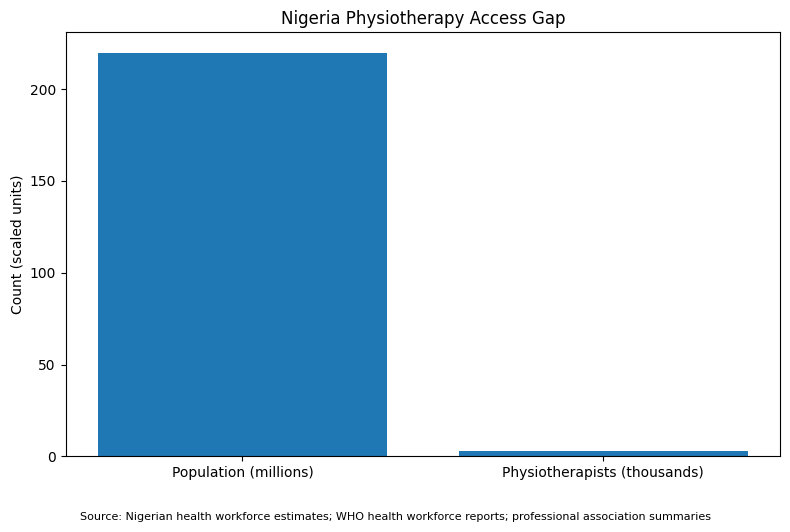
ODA, now newly launched, is part AI-powered health tool, part tele-rehabilitation system, and part grassroots response to a system where, according to medical workforce estimates, Nigeria has fewer than 3,000 physiotherapists serving over 220 million people, roughly one physiotherapist per 100,000 citizens.
Most are concentrated in Lagos, Abuja, and Port Harcourt. For everyone else, care is often out of reach.
A system where recovery depends on location
Nigeria’s physiotherapy shortage is not just a staffing issue, it is a geography problem. A large share of rehabilitation services remain urban-centred, leaving rural and semi-urban communities with limited or no access. This pattern mirrors broader digital health inequalities in the country. Recent evidence shows:
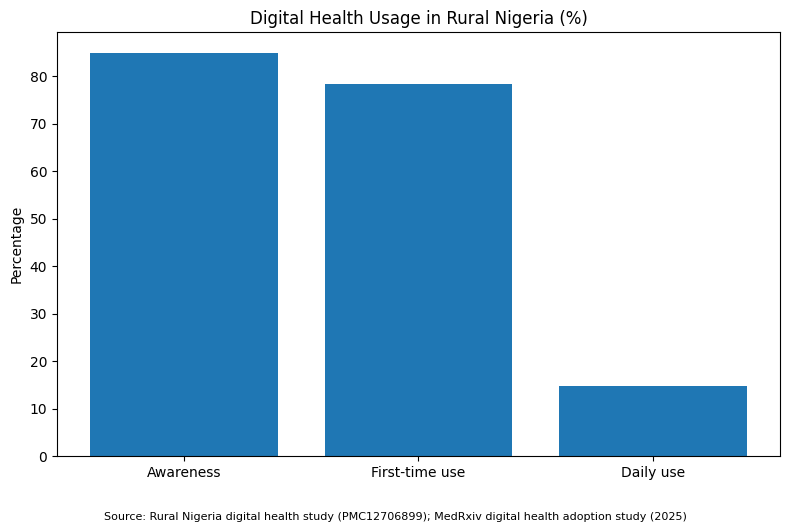
- 78.3% of rural residents have used digital health tools at least once, but only 14.7% use them daily
- Nigeria’s digital health ecosystem faces major rural barriers including connectivity, literacy, and infrastructure gaps
Even where awareness exists, sustained use remains low. Across multiple studies, the pattern is consistent: digital tools exist, but consistent access does not
The moment that started it
For Daniels, the idea for ODA was not born in a boardroom or incubator, it began in a hospital corridor. Her brother tore his ACL in late 2025.The surgery, she says, was only the beginning.
“Surgery was just about 10% of the battle. The reality of recovery is the 90% that comes after.”
That “90%” is physiotherapy, structured movement, guided rehabilitation, pain management, and long-term recovery support. In Nigeria, it is often expensive, inconsistent, or unavailable. That gap is what Daniels calls “the invisible crisis.”
“An elderly woman with arthritis is told it is just aging. A new mother with pelvic complications is told to manage it. A young athlete tears his ACL and his career is over” she adds.
In Nigeria, where road traffic accidents remain among the highest globally, injuries are constant. Recovery support, however, is not.
What ODA is trying to fix
ODA, Open Doors Access, is a free AI-powered rehabilitation platform available at app.opendoorsaccess.com.
It is designed to bring physiotherapy out of clinics and into homes.
How it works (simplified)
- Users complete a health assessment (injury, pain, mobility, recovery goals)
- AI generates a personalised rehabilitation plan
- Structured exercises and progression are delivered digitally
- Licensed physiotherapists can monitor and adjust care remotely
- Patients can optionally upgrade to video consultations
Daniels is careful about one distinction, “ODA is not replacing physiotherapists, it is extending their reach.”
A physiotherapist in Lagos can now support a patient recovering in Sokoto without physical travel.
Digital health in Nigeria: Promise vs reality
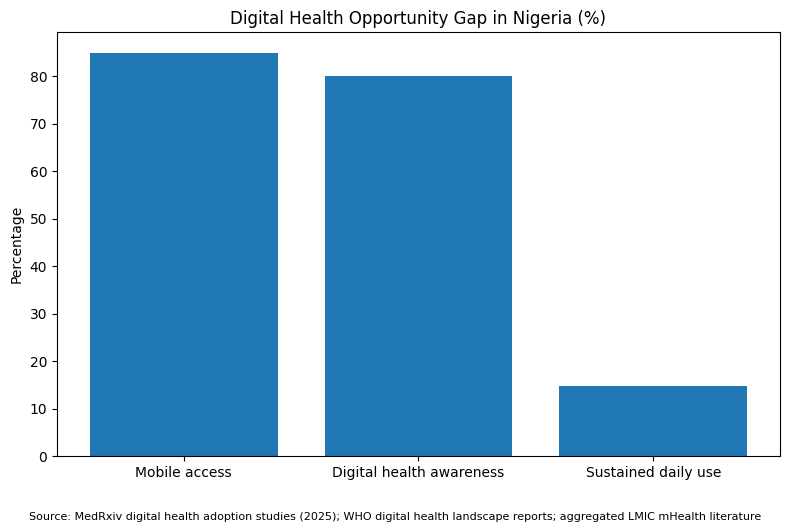
Nigeria is rapidly digitising healthcare, but adoption is uneven. A broader review of digital health systems in Nigeria shows:
- High awareness of digital health tools (80–85%)
- Moderate-to-high provider adoption (70%+ among professionals)
- Low sustained patient usage in rural communities (14.7% daily use)
Even as mobile penetration supports expansion, usage consistency remains a challenge.
Digital Health Reality in Rural Nigeria
Key barriers:
– Data cost
– Connectivity
– Low digital literacy
A platform built for real-world limitations
One of ODA’s most deliberate design choices is accessibility. Nigeria’s rural communities face uneven connectivity and high data costs, both major barriers to digital health adoption. Daniels says ODA is being built to work under those constraints.
- Low-data design
- Offline-friendly structure (in development focus)
- Partnerships with clinics and NGOs for shared-device access points
“We are focused on making ODA as lightweight and data-efficient as possible,” she explains.
Language as access
ODA currently supports four languages:
- Pidgin (default)
- English
- Yoruba
- Hausa
- Igbo
In a country where language can determine whether care is understood or ignored, this is not a cosmetic feature, it is a clinical access decision.
The trust problem
Digital health in Nigeria is not only a technology challenge, it is a trust challenge. A major barrier in adoption is concern over privacy, misinformation, and legitimacy of care. Daniels acknowledges this directly.
ODA aligns with Nigeria Data Protection Regulation (NDPR) standards and does not sell user data.
But beyond policy, she believes trust is earned through outcomes.
“Trust is built through transparency, consistency, education, and real patient outcomes.”
How ODA is trying to prevent fake practitioners
To avoid one of the biggest risks in telehealth, impersonation, ODA requires verification.
Every physiotherapist must submit credentials from the:
- Medical Rehabilitation Therapists Board of Nigeria (MRTB)
Each application is manually reviewed before approval.
No verification, no access.
Who it is for
ODA serves two groups:
1. Patients
- Post-surgery recovery
- Stroke rehabilitation
- Back pain and joint conditions
- Postpartum recovery
- Sports injuries
2. Physiotherapists
- Remote patient management
- Expanded geographic reach
- Hybrid care (in-person + digital follow-up)
The human story behind the technology
Daniels frames ODA less as a startup and more as a correction. A correction to a system where recovery depends on geography, income, and luck. Nigeria’s healthcare challenges are not unique, but the scale of unmet rehabilitation need is stark.
Globally, digital health tools are increasingly seen as a bridge. Studies show that mHealth platforms can improve health behaviours and increase access to care when properly implemented. But implementation is everything. And in Nigeria, implementation is the hardest part.
Early response and growth
Although still newly launched, ODA has already seen early traction:
- Physiotherapists joined the platform waitlist without major marketing campaigns
- Early users report positive reception
- Clinical partnership already established with a physiotherapist with 22 years of experience
Daniels says the response has been “encouraging but expected.”
“It addresses a real and overlooked problem.”
The big challenges ahead
ODA’s founder identifies three major risks:
1. Connectivity & Data Cost
Even the best-designed app fails if users cannot afford to stay online.
2. Trust
Users must believe digital rehabilitation works as effectively as in-person care.
3. Sustainability
Keeping the platform free or affordable while scaling nationally.
The biggest question: can digital care close the gap?
Across Nigeria’s health system, digital tools are expanding, but unevenly.
Evidence shows strong potential:
- High mobile penetration supports mHealth expansion
- Provider-side adoption is already strong
- But patient-side sustained use remains low in rural communities
This tension defines ODA’s mission.
What success would look like
For Daniels, success is not downloads or growth metrics.
It is simpler:
- A woman recovering from childbirth pain without suffering in silence
- A road accident victim regaining mobility without leaving their community
- A young athlete getting a second chance at a career
Or as she puts it
“If we can alleviate even one part of suffering, then let’s do it.”
Nigeria’s healthcare system is often described in terms of shortages, doctors, hospitals, funding.
But ODA is built around a different idea: that access itself is a form of treatment.
And in a country where millions recover alone, that idea may be the most important medicine of all.