
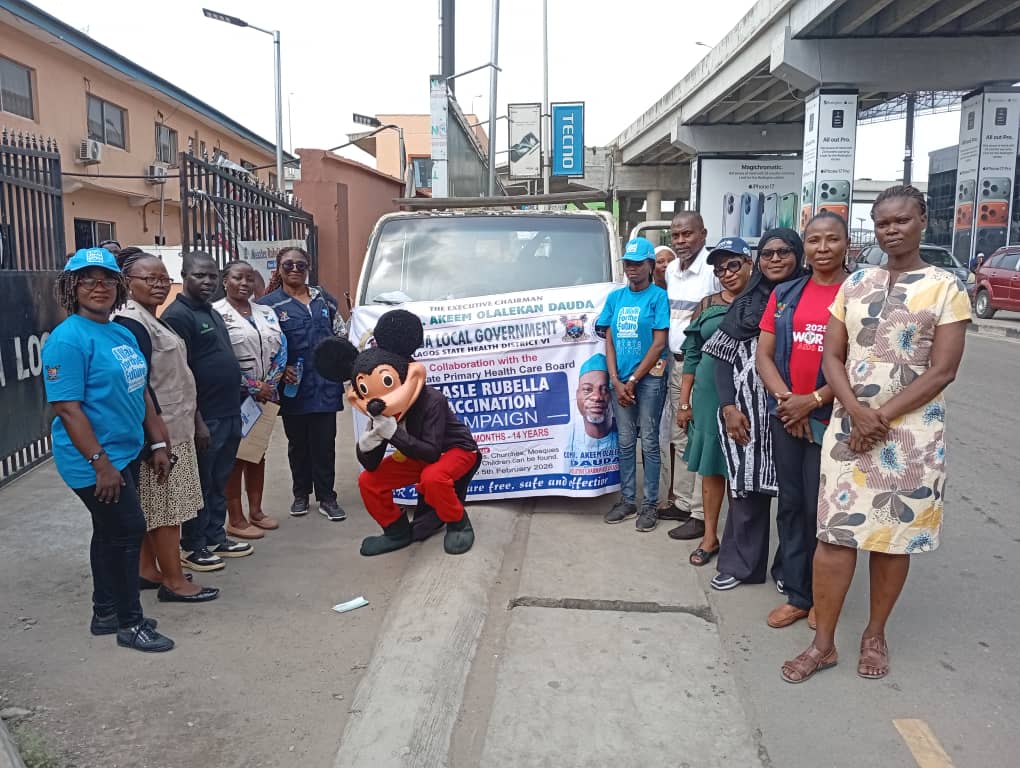
Lagos State has launched a large-scale measles–rubella (MR) vaccination campaign targeting more than 10 million children, as health officials warn of increasing rubella cases and the risk of outbreaks if immunisation gaps persist.
The campaign, flagged off on Jan. 27 in Ibeju-Lekki, introduces the combined MR vaccine into the state’s routine immunisation schedule, aimed at children aged nine months to 14 years.
In an interview with HeapNews, Rashidat Sanni-Afolabi, Health Education and Health Promotion Officer for Ikeja Local Government, explains the strategy, risks and public response.
Q: Lagos State is currently carrying out a sensitisation programme on the measles–rubella vaccination campaign. Can you explain what this involves?
A: The measles–rubella vaccination campaign is in its introductory phase. What we are doing is integrating rubella into the existing measles vaccination for eligible children. Through the National Primary Health Care Development Agency and the Lagos State Primary Health Care Board, and down to the local governments, we are vaccinating children from nine months up to 14 years, irrespective of their previous immunisation status.
This means that even if a child has already received measles or other vaccines, they still need this one. The extension to 14 years is to ensure broader coverage and to achieve what we call herd immunity. We are targeting between 85% and 90% coverage, about 10.5 million children, and we are making steady progress.
Q: What communities have you visited so far, and how have people responded?
A: We are covering every part of the state-urban, semi-urban, and even riverine communities. This is not a house-to-house campaign because the vaccine is injectable, so we are using temporary fixed posts.
These include schools, churches, mosques, markets, malls, anywhere we can reach a large number of eligible children. We also have fixed posts at primary health centres and general hospitals where people can walk in.
The response has been encouraging overall, though like any public health campaign, we continue sensitisation to address concerns and improve uptake. Our goal is to ensure no child is left unreached.
Q: Why is this campaign being rolled out at this time?
A: It is largely due to the increase in reported cases. Many cases previously thought to be measles have, through active surveillance, been identified as rubella.
If we do not act now, there is a risk of an outbreak. Both infections are highly contagious, but while measles is more severe in the short term, rubella can have more serious long-term consequences, especially for pregnant women.
If a pregnant woman contracts rubella, it can lead to congenital rubella syndrome in the unborn child, causing blindness, deafness or deformities. That is something we must prevent.
Q: Is rubella a form of measles, or are they different diseases?
A: They are different diseases, although they share similar symptoms. Both can present with cough, runny nose, red eyes, fever and a generalised rash. However, rubella symptoms are usually milder.
Because of these similarities, rubella is often mistaken for measles. But the complications can differ. In individuals with low immunity, both infections can lead to serious conditions such as pneumonia or encephalitis.
This is why prevention is critical. Vaccination is the most effective way to protect children and reduce transmission in the community.
Q: What is your key message to parents and caregivers?
A: My message is simple: vaccination is safe, effective and necessary. Even if your child has been vaccinated before, they still need this combined vaccine.
We are bringing services closer to the people, so there is no reason to miss out. Protect your children now so we can prevent avoidable diseases and safeguard their future.
Rubella, transmitted through airborne droplets, is typically a mild viral infection in children but poses severe risks during pregnancy, including miscarriage and congenital defects. Global vaccination efforts have eliminated the disease in more than 90 countries, but gaps in coverage continue to leave populations vulnerable in parts of Africa.
For Lagos, authorities say the success of the current campaign will depend on sustained public awareness and community participation.
“We are making progress,” Sanni-Afolabi said. “But reaching every child remains the priority.”