
State provides tricycles, power tillers and processing equipment to boost rural incomes, reduce post-harvest losses and promote inclusive agriculture.
By Heapnews
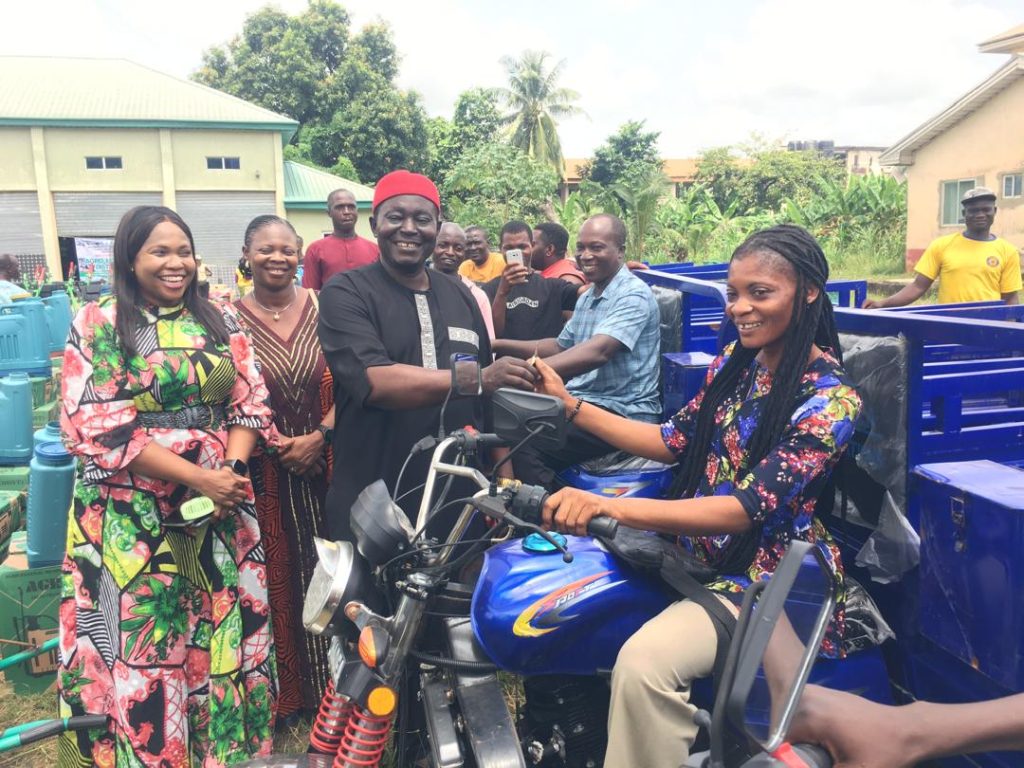
At least 500 farmers in Nigeria’s Anambra State have benefited from the distribution of agricultural equipment under a Federal Government and International Fund for Agricultural Development (IFAD) programme aimed at improving rural livelihoods and increasing agricultural productivity.
The equipment, distributed by the state Ministry of Agriculture under the Value Chain Development Programme (VCDP), included 49 tricycles, 84 power tillers, 80 solar-powered water pumps, 200 knapsack sprayers and fertiliser applicators, as well as equipment for cassava and rice processing.
Cooking demonstration equipment was also provided for 50 women to promote improved food preparation and nutrition practices.
Speaking at the flag-off ceremony in Awka on Monday, Deborah Onyefulu, the state programme coordinator of IFAD-VCDP, said the intervention was designed to expand opportunities for women, young people and persons with disabilities in agriculture.
She said the programme sought to increase rural farmers’ incomes, create jobs, reduce poverty and contribute to the state’s internally generated revenue.
“The equipment support is part of the programme’s initiative to support women, youths and persons with disabilities,” Onyefulu said, adding that the initiative was intended to promote inclusion across agricultural value chains and improve farmers’ incomes sustainably.
She warned beneficiaries against selling the equipment, saying a monitoring team had been established to ensure the items were used for their intended purposes.
Matthew Okafor, acting state agricultural production officer for value chains, said beneficiaries were selected through liaison officers in nine participating local government areas.
Under the arrangement, beneficiaries are expected to contribute 30% of the equipment’s cost, while the government covers the remaining 70%, he said.
Okafor urged farmers to accept only equipment relevant to their needs so that available support could reach those who required it most.
Mary Obiekwe, the programme’s acting business and market development officer in Anambra, said 50 selected farmers would each receive a tricycle to ease the transportation of agricultural produce from farms to markets.
She said poor transport links and limited access to remote farming communities had contributed to post-harvest losses, particularly among farmers who struggled to move their produce to buyers.
“With the distribution of these tricycles, there will be seamless transportation and increased productivity,” Obiekwe said.
She urged beneficiaries to maintain the vehicles properly and develop a savings culture to help them replace the equipment when it depreciated.
The initiative also attracted support from state officials, including Anthony Muobike, a member of the Anambra State House of Assembly representing Aguata Constituency II, who urged farmers to use the equipment responsibly.
Chinwe Achugbu, the permanent secretary of the state Ministry of Agriculture, represented by Ify Onyenwe, commended the programme for supporting farmers’ livelihoods and creating opportunities for agricultural development.
For some beneficiaries, the equipment represents a practical solution to the challenges of moving produce and sustaining farm operations.
Onyebuchi Okoli, a member of the Destiny Farmers Cooperative in Isuaniocha, Awka North Local Government Area, said the tricycle would make it easier for her to transport vegetables, cassava and fish to market.
Okoli, who practises vegetable, cassava and fish farming, also credited the programme with providing training to help farmers improve their livelihoods.
“They taught us how farming can improve our livelihoods,” she said.
The distribution is part of broader efforts to strengthen agricultural value chains by improving access to equipment, supporting processing and making it easier for rural farmers to connect with markets.