
610,000 malaria deaths globally in 2024, up from 598,000 in 2023
95% of global deaths concentrated in Africa, 75% among children under 5
282 million malaria cases in 2024, 9 million more than the year before
Every minute, somewhere in Africa, a child under five dies from malaria, a disease that is both preventable and treatable. According to the WHO World Malaria Report 2025, there were 282 million malaria cases and 610,000 deaths worldwide in 2024, with the African region shouldering 95% of that burden. Nigeria alone accounts for nearly a third of all African deaths. Meanwhile, the tools we have relied on for decades, insecticide-treated nets, artemisinin-based drugs, are increasingly losing the battle against resistant parasites and adaptive mosquitoes. And the funding gap is staggering: in 2024, global malaria financing stood at $3.9 billion, less than half the $9.3 billion target.
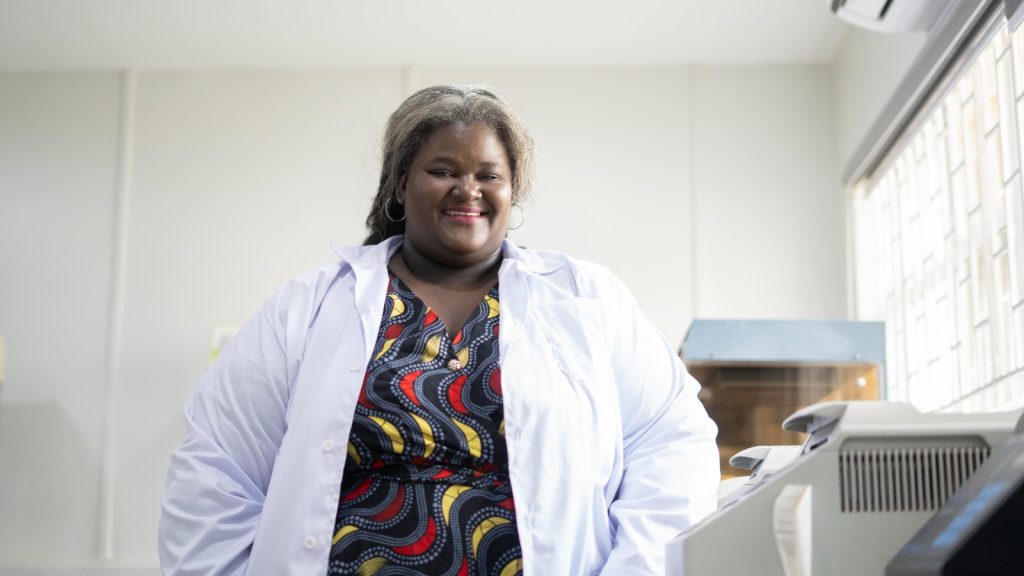
Yet amid these grim numbers, there is science that dares to think differently. On this World Malaria Day 2026, under the theme Driven to End Malaria: Now We Can. Now We Must., Bunmi Yekini spoke with Krystal Mwesiga Birungi, a scientist, entomologist, and malaria advocate based at Target Malaria’s Uganda hub at the Uganda Virus Research Institute. Her work sits at the frontier of genetic innovation, developing next-generation tools to suppress the mosquitoes that spread the disease. In this wide-ranging conversation, she speaks candidly about resistance, African ownership of science, the barriers women face, and why the window to act is now.
Despite decades of interventions, malaria still kills hundreds of thousands across Africa each year. What is the single biggest political or systemic barrier preventing elimination, and who needs to be held accountable for it?
I wouldn’t say it comes down to just one systemic or political issue. Rather, it is a combination of challenges that has left us unable to reach malaria elimination. That said, the problem I keep returning to is resistance, in its several forms.
First, there is drug resistance. Over time, the malaria parasite adapts to existing medications, rendering them ineffective and forcing scientists to develop new ones. Many Africans will remember taking chloroquine or fansidar; today, we rely on Artemisinin-Combined Therapies. But even those are under threat. According to the latest WHO report, partial resistance to ACTs has already been confirmed in at least four African countries, including Uganda. Resistance historically appears in the east and spreads westward, so this is not just a warning sign, it is a forecast.
"We're basically playing catch-up to the disease."
Then there is insecticide resistance. Treated nets and indoor spraying have been cornerstones of malaria control, but mosquitoes have adapted. In 48 of 53 reporting African countries, resistance to pyrethroids, the primary chemical used in bed nets, is now confirmed. The tool is not as effective as it once was, and transmission continues.
We are also seeing what I call behavioural resistance. Mosquitoes that typically bite indoors at night, the very window that bed nets target, are now biting earlier in the evening or at dawn, after people are already awake. So while the nets still protect people while they sleep, there is a growing gap in coverage during the hours these adapted mosquitoes are active.
Taken together, these forms of resistance mean we are constantly racing to stay relevant against a rapidly evolving disease.
Why is it important for Africa to be involved in developing its own malaria solutions?
Historically, tools and technologies have been developed in the Global North even when the primary problem exists in Africa and the intended beneficiaries are African. Consider this: almost all mosquito nets and malaria drugs are distributed within Africa, yet almost none are produced on the continent. That disconnect creates real problems.
A simple example: mosquito nets have been produced in square shapes for distribution in communities where people live in round huts. Without the correct anchor points in their homes, people simply cannot hang the nets. That failure could have been easily avoided if the communities meant to use the tool had been involved in its design from the start.
“Small things like this end up not being small at all they can determine whether a tool succeeds or fails entirely.”
The good news is that this is changing. More and more collaborations are emerging between African scientists and Global North institutions, with genuine technology transfer, where significant portions of the work, and sometimes all of it, are actually conducted in Africa. Target Malaria is one example: we work in close partnership with the Uganda Virus Research Institute to ensure that when a finished product exists, it carries African ownership, reflects African contexts, and is tailored to local conditions.
The malaria vaccines offer another encouraging model. The final trials for the R21 vaccine were conducted in Ghana, in collaboration with Ghanaian institutions. That partnership shaped both the vaccine’s acceptance in those communities and the practical logistics, including timing the doses to align with existing immunisation schedules. These are not small wins. They are the difference between a tool that gets used and one that sits in a warehouse.
Ultimately, African scientists, legislators, and regulators must make an intentional effort to ensure that African populations are not merely recipients of global health solutions, but are co-creators, and sometimes leaders, of the tools designed to serve them.
How can African countries move from being recipients of global health solutions to setting their own agenda?
The shift requires intentionality above everything else. It requires African countries to prioritise their own health and technology budgets, to say plainly: this matters to us, and we are willing to invest in it. For as long as the continent does not dedicate meaningful domestic resources, financial, policy, and regulatory, to its own health agenda, the dependency will persist.
This cannot be left to scientists alone. It will require political will, policy adjustment, and regulatory reform. But the encouraging thing is that we are already seeing it happen. The Yaoundé Declaration was a meaningful step, high-burden, high-impact countries coming together to pledge that malaria elimination would be a priority in their budgets and policy agendas.
“Steps like that will enable Africa to move from just a recipient to actually setting the agenda.”
Declarations must be matched with budgets and accountability mechanisms. Political commitment that is not backed by real financing rarely translates into action. But I am genuinely encouraged by the direction of travel. The will is growing. Now it must be institutionalised.
Why are women important in the fight against malaria, and what challenges limit their participation?
Women are among the most affected by malaria at every level. Pregnant women are one of the most vulnerable groups, alongside children under five. And in most of Africa, women are also the primary caregivers for those children — meaning that when a child falls ill, it is typically a woman who misses work, loses income, or bears the physical and emotional burden of care. Women are simultaneously the most affected by malaria and the most needed in the fight against it.
That makes it all the more important that women are represented in the research, the technology development, and the decision-making around malaria solutions. But this is going to require systemic change, and that change has to begin very early.
“If we do not change the message that girls receive from birth, that science is not for them, we will keep losing half our potential talent before it is ever developed.”
In many places, young girls are steered toward careers perceived as less demanding or more compatible with domestic responsibilities. Scientific and research fields are frequently presented as incompatible with womanhood. The result is fewer girls pursuing science, fewer women entering research, and a depleted pipeline at the very moment the field needs all the talent it can get.
But the problem does not end at recruitment. Even women who do enter the sciences often fail to be retained, because workplace environments are not designed with them in mind. Something as simple as a lactation room, or a meaningful maternity leave policy, can determine whether a skilled woman stays in her role or leaves. And beyond infrastructure, there is the weight of patriarchal expectations: the assumption that leaders are male, the subtle (and not-so-subtle) resistance that women face when trying to assert authority or be taken seriously.
Changing this requires educating not only women, but men. It means building a culture where fathers encourage their daughters into science, where male colleagues advocate for their female peers, and where the default assumption about who belongs in a laboratory is fundamentally reset. We are currently leaving the contributions of 50% of the population on the table. That is a cost no field fighting a disease of this scale can afford.
What is the current progress of the Target Malaria project, and what comes next?
We have reached what scientists call proof of concept. In contained laboratory settings, first in small cages, then in large ones, we have demonstrated that when genetically modified mosquitoes are introduced into a population, the overall numbers decline over time. That is a meaningful milestone. But it is important to be clear: no gene-drive mosquito has ever been released into the open environment anywhere in the world. All our current work is conducted under strict containment, nothing enters or exits our facilities without deliberate intent.
At Uganda’s Arthropod Containment Level 2 laboratory at the Uganda Virus Research Institute, we are working with a strain of modified mosquito designed to skew the sex ratio of offspring. Under normal circumstances, a mosquito produces roughly 50% male and 50% female eggs. Our modified mosquitoes produce over 90% male offspring. Since only female mosquitoes bite and transmit malaria, disrupting that balance reduces transmission potential significantly. This current strain does not carry a gene drive, that would be the next phase of development.
“We are at the stage where science has delivered proof of concept. Now comes the rigorous, painstaking work of turning that into something we can responsibly release into the world.”
The next step is field trials. But that requires extensive legislative and regulatory preparation, filing the dossiers, compiling the data, engaging the relevant authorities, and obtaining the permits that would allow a controlled, small-scale open release. That process is already underway. If things proceed as planned, we are targeting small-scale field releases by 2030.
What causes malaria, and which parasites are most common in Africa?
Malaria is caused by a parasite called Plasmodium. There are several species of Plasmodium, but within Africa, the most prevalent, and most dangerous, is Plasmodium falciparum. It is both the most common and the most virulent; infections are more severe and more likely to be fatal compared to other species. Other types such as Plasmodium malariae and Plasmodium vivax (more common in Asia) can also be found in Africa, but P. falciparum is responsible for the overwhelming majority of cases and deaths on the continent.
At Target Malaria, we are not conducting infection studies. Our focus is on the vector, the mosquito that carries and spreads the parasite. The logic is this: by reducing the populations of the specific mosquito species responsible for malaria transmission, we interrupt the chain that allows the disease to spread in the first place. That is the gap we are working to fill, one that existing tools have not been able to close.
Which mosquito species are responsible for malaria transmission in Africa?
Of the more than 3,500 mosquito species that exist worldwide, only a small number transmit malaria. On the African continent, three species are responsible for the vast majority of malaria transmission, and those are precisely the three that Target Malaria is targeting.
The first is Anopheles gambiae, found across much of sub-Saharan Africa and one of the most significant vectors on the continent. The second is Anopheles arabiensis, also widely distributed and deeply implicated in transmission. The third is Anopheles coluzzii, which is concentrated in West Africa and plays a major role in transmission in that region, though it is not significantly present in East Africa.
“Out of 3,500 species, we have zeroed in on three culprits. That precision is the point, we are not trying to eliminate all mosquitoes, only the ones perpetuating this burden.”
There is a fourth species that contributes to a lesser degree, but by focusing on these three, we are targeting what accounts for almost all malaria transmission across Africa.
Which African countries are currently involved in your work? And notably, why is Nigeria not among them, given its enormous malaria burden?
Our African work is currently concentrated in Uganda. We have had past partnerships with Ghana, Cape Verde, and Burkina Faso, though activities in Burkina Faso are currently paused. More African countries may come on board in the future as the project progresses.
As for Nigeria, it is a fair question. The project began with specific institutional partners in West Africa: Mali’s Malaria Research and Training Center and Burkina Faso’s Institut de Recherche en Sciences de la Santé, alongside Uganda in East Africa. Nigeria was not part of that initial grouping, but that is not a reflection of its importance. Nigeria carries the heaviest malaria burden of any country in the world, and this is a not-for-profit initiative. When and if a tool is ready, it will be available to every country, including Nigeria, at no cost. Each government will then decide independently whether it wishes to adopt the technology. We certainly welcome interest from any institution that wants to join. Who knows? Nigeria may well become a partner yet.
How do you ensure that new malaria technologies are safe before they are deployed?
Safety is non-negotiable. With any new innovation, it is absolutely essential that tools are both safe and effective before they reach communities. What I want people to understand is that most countries already have robust structures in place to ensure exactly this.
In Uganda, for example, the Uganda National Council for Science and Technology oversees a National Biosafety Committee that is specifically responsible for reviewing and regulating work with genetically modified organisms. These structures exist. The regulations exist. When properly followed, and part of the job of these regulatory bodies is to ensure they are, they provide meaningful safeguards at every stage of development and deployment.
“We are in a race against time. But speed and safety are not opposites, they require each other. A tool that harms communities is no tool at all.”
We are not moving faster than our ethical safeguards. This is a case-by-case process, rigorous, methodical, and shared across scientists, regulators, and government bodies. The goal is not simply to do things safely, but to do them as efficiently as possible within that safety framework, so that we can actually save lives from a disease that is still claiming hundreds of thousands of them every year.
How do you address public concerns and build acceptance for new malaria interventions, and how do you measure whether trust has truly been earned?
With any new technology, apprehension is natural. People are encountering something unfamiliar, and that uncertainty is understandable. But here is the crucial point: community acceptance is not optional. You can spend decades developing a genetically modified mosquito or a new vaccine, and if the people it is meant to serve do not trust it, they will not use it. The tool will fail regardless of how scientifically sound it is.
That is why communication cannot be an afterthought. Waiting until a tool is ready to begin engaging communities is, frankly, wasted time — because by then you are already behind. Effective engagement needs to happen in parallel with development, transparently and consistently, so that communities understand not just what the tool is, but why it is being developed and how it might serve them.
Effective communication also means co-designing the messaging with communities themselves. Sometimes what you think you said is not what was heard, especially across languages. At Target Malaria, when we develop communications tools for local deployment, we work with language experts and community focus groups to develop locally appropriate terminology for concepts like ‘gene drive’ or ‘genetic modification’, concepts that may have no direct equivalent in many languages. Direct translation is not enough. The meaning has to land.
“Without a mechanism for feedback, you cannot know whether your message is reaching anyone, or whether you are speaking into a void.”
To measure whether trust has genuinely been built, we maintain a grievance mechanism, formal channels through which community members, government bodies, and other stakeholders can share concerns, flag misinformation, or ask questions they did not feel comfortable raising in a public forum. And we work with community-selected representatives who can provide structured feedback on how the broader population is responding to the technology. These people must have been genuinely selected by an informed, well-engaged community, not appointed top-down. That authenticity matters enormously.
Is it labour-intensive? Yes. But the alternative, pushing a technology into communities that do not understand or trust it, squanders not just the money spent on development, but also the chance to actually end malaria.
Are African regulatory systems strong enough to manage emerging technologies like genetically modified mosquitoes?
I think African regulatory systems have a great deal more capacity than the world tends to give them credit for. In most countries, there are already structures in place to govern research into genetically modified organisms, and in some cases, their deployment. Uganda, for instance, has substantial legislation covering research into GMOs, and its relevant regulatory body has accumulated considerable experience through years of overseeing field trials, predominantly in agriculture, but with transferable expertise that applies directly to what we are doing.
African regulators are not starting from zero. They have access to international guidelines and standards. They have scientists, environmental experts, and technical specialists within their borders whose knowledge can be drawn upon. Yes, for countries that have never encountered genetically modified organisms before, capacity-building will be needed. But that is a very different situation from having no foundation at all.
“As Africans, we need to have confidence and faith in our own regulatory systems. They are working on our behalf, and they are doing it seriously.”
There is also meaningful investment happening at the continental level. The African Union Development Agency (AUDA-NEPAD), for example, is actively working to build regulatory capacity across African countries in preparation for next-generation technologies. The architecture is being built.
I am genuinely confident that Africa will be ready for these new tools as they become available. Our regulators will handle this. And I think it is time the world, and we ourselves, started believing that.